
Luxury tourism is forecast to outpace general tourism over the next five years, according to the latest DossierPlus by Statista report. In 2019, global tourism revenue amounted to US$5.9 trillion. The compound annual growth rate of tourism in general is 6.4%, while the luxury segment is expected to be fractionally higher, at 7.3%. With a global value of US$ 831 billion, luxury travel stands out as a prime revenue driver.
The data revealed by Statista shows predominant trends, such as the most significant travel destinations per region and a revenue forecast for up to 2023. The United States currently has the biggest luxury travel market with a value of nearly US$263 billion in 2019. The USA is followed by China in second with a market value of nearly a third of that of America, at approximately US$91 billion. Germany accounted for US$58 billion and Mexico US$18 billion.
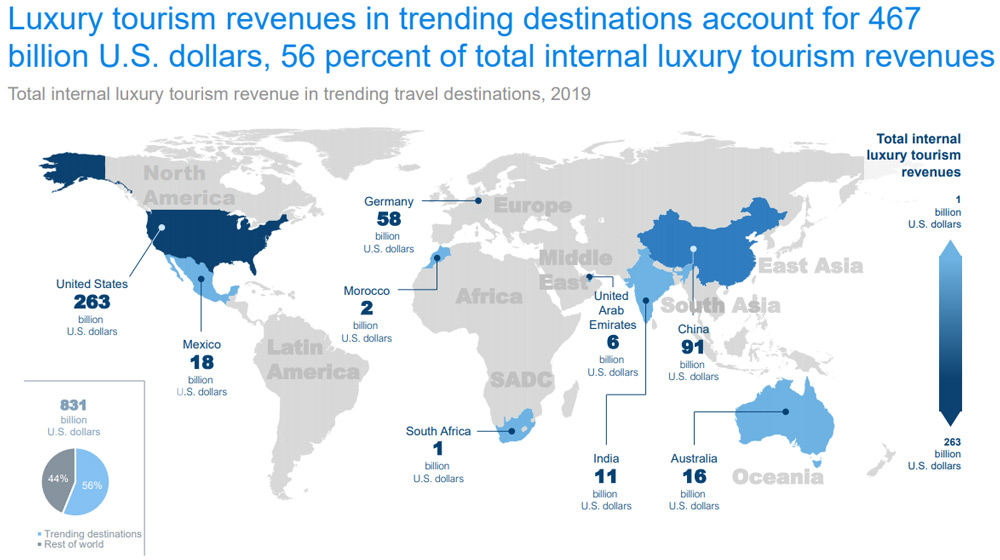
The study found China and India’s luxury markets are forecast to grow the most rapidly in the next five years, driven by the growth of the domestic luxury market.
For Australia, Statista says luxury tourism revenue is currently valued at US$16 billion, of which $13 billion is spent domestically. That number is predicted to stay flat in 2020, whereas international luxury tourism will rise from US$3 billion to US$4 billion. By 2023, Australia’s luxury tourism revenue is expected to top US$18 billion, driven by domestic travellers (at approximately US$15 billion).
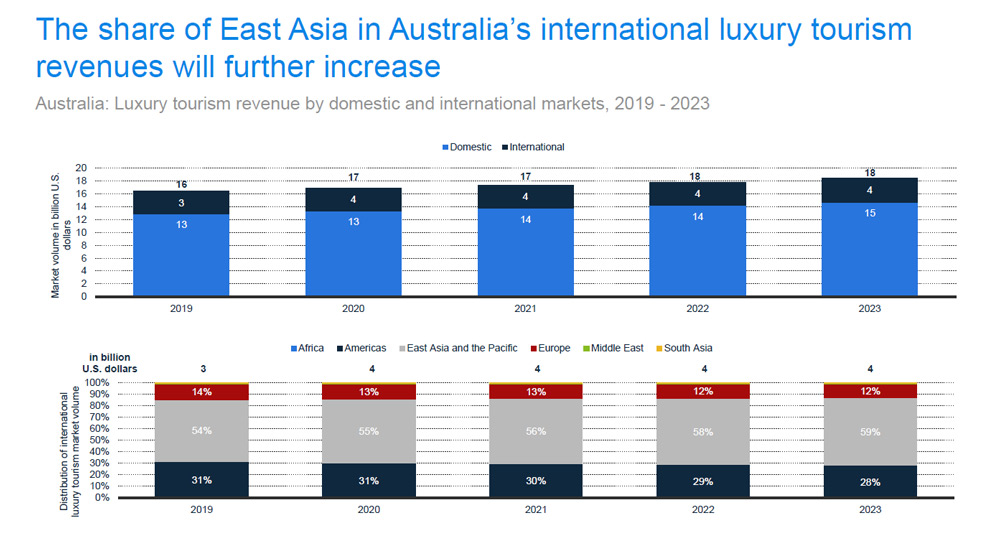
Over the next five years, East Asia and the Pacific are tipped to receive the largest share of Australia’s international tourism revenue, rising from 54% in 2019 to 59% by 2023. Revenue is expected to dip slightly for the Americas market (from 31% to 28%) and Europe (from 14% to 12%).
Dr. Friedrich Schwandt, Founder and Managing Director of Statista, emphasised that “The luxury tourism market accounts for 14% of the revenues today already. This makes it a highly competitive growth environment.”
“A key trend that has been shaping luxury tourism in recent years is the increase in multigenerational travel. Families are seeking an opportunity to spend quality time together and strengthen bonds. As Millennials and Generation Z gain economic influence and represent an increasing proportion of luxury travellers, adventure, uniqueness, as well as sustainability also become vital, as they contribute to a high-profile social media image,” Schwandt said.
Statista’s study provides detailed information on the luxury tourism industry of nine countries, including Australia. The other eight are the United States, China, Germany, India, Mexico, the United Arab Emirates, South Africa and Morocco.
For more information and to purchase the report, click here.Want to be in the luxury travel know? Subscribe to our free eNewsletter here to keep up to date with everything in the luxury travel industry.