
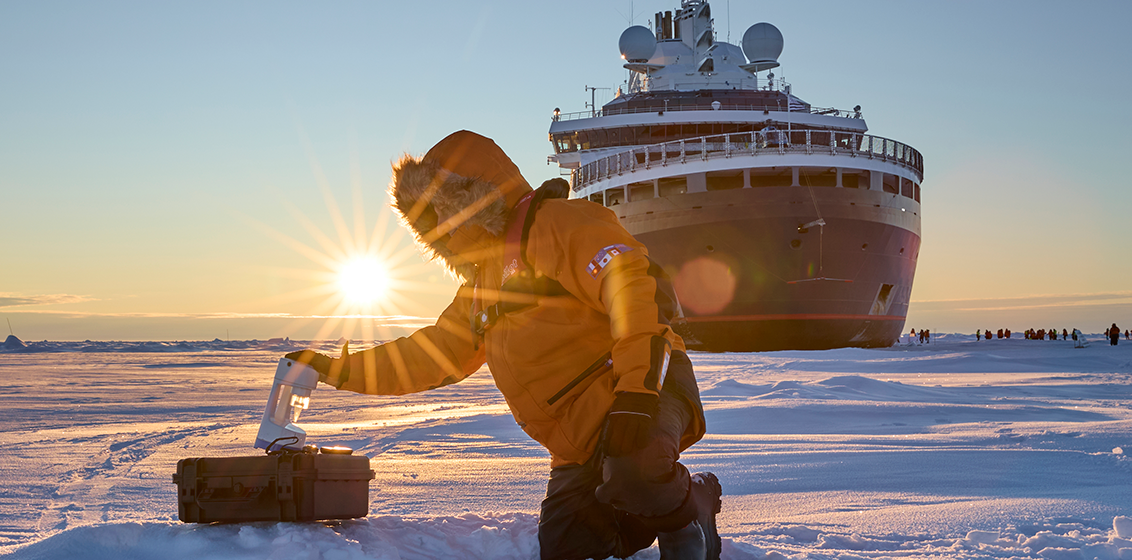
A recent voyage aboard PONANT’s Le Commandant Charcot saw a team of 20 scientists from around the world study the effects of global warming in the rapidly changing polar region.
This milestone mission began with the first ever crossing of the Arctic Ocean from west to east in September 2024, with the journey spanning 6,400 kilometers between Alaska and Spitsbergen as part of the CHARCOT project.
“This large-scale multi-disciplinary operation brought together 20 scientists of seven nationalities from 11 universities and institutes, leading six missions in fields such as the carbon cycle, ecosystem functions, and microplastics,” Scientific Coordinator of the PONANT Science program Daniel Cron said.
“It was a real challenge to coordinate the different types of samples, at all times of the day and night, and adapt to unknown ice conditions.”

Subscribe to LATTE’s free eNewsletter to keep up to date with everything in the luxury travel industry.
Guests aboard the vessel were encouraged to engage with the scientists through the Science Talks program, where the experts shared their knowledge, offering insights into the sample collection process, and leading discussions on topics like biogeochemistry and Arctic ecosystems.
In 2025, guests can join a similar expedition – Transarctic, the Quest for the Two North Poles, from Longyearbyen to Nome.
Meanwhile, the PONANT Science Program continues to expand, with multiple ships hosting scientific research projects and data being made available for open-source use.
Le Commandant Charcot, the world’s only luxury icebreaker, was purpose-built for extreme environments. Its Polar Class 2 hull enables it to navigate polar waters, while its hybrid electric propulsion powered by liquefied natural gas (LNG) minimises environmental impact. The ship’s state-of-the-art laboratories—both dry and wet—allow scientists to collect and analyze samples from the air, ice, and water, while the newly installed Sea Ice Monitoring Station continuously measures ice thickness.